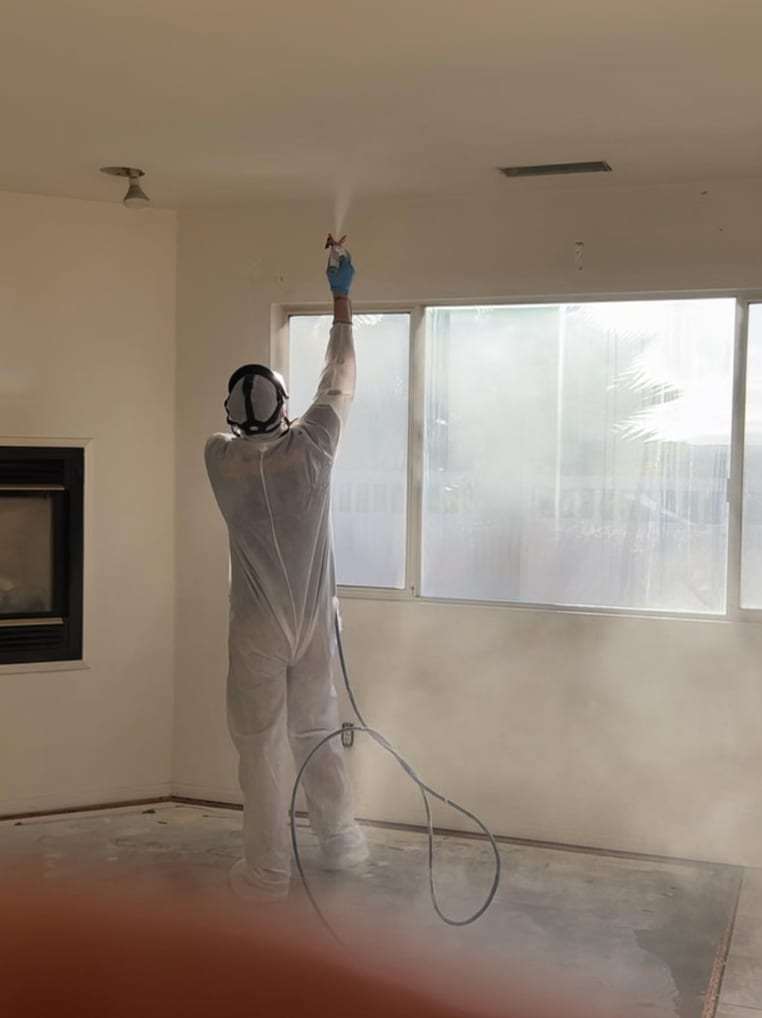
Technician in a protective suit spraying a ceiling in an empty room. Example of the work involved; the photo does not show a specific property or a job for this site.
Why crawlspaces are hard
Plenty of houses in the area sit partly or entirely over a crawlspace rather than a full basement, and many full-basement houses have a crawlspace under a later rear addition or a sunroom. Those spaces are usually vented to the outside through small openings at the foundation, and an old vent screen that has rusted or been pushed in is an easy entry for a skunk.
Inside, the materials are almost all porous. Exposed soil or a plastic vapor barrier covers the ground. Fiberglass batts hang between floor joists, sometimes sagging. Ductwork may run through the space. When a skunk sprays there, the oil coats soil, plastic, wood and insulation, and the odor rises straight into the floor above. Because the crawlspace connects to rooms through plumbing penetrations and gaps in the subfloor, the house above can smell strongly even when nobody can see the source.
Treat in place or remove?
Most crawlspace jobs end up as a mix of both. These are the usual dividing lines.
Usually treatable in place
- Wood framing and the underside of subfloor that took light contact
- Concrete or masonry foundation walls
- Metal ductwork exteriors that can be wiped and treated
- Lightly affected soil that can be treated and covered
Often better removed and replaced
- Fiberglass batts that took a direct hit
- Torn or soaked vapor barrier plastic
- Flex duct or duct wrap that absorbed odor
- Debris, stored items and nesting material left behind by the animal
- Heavily saturated soil near the spray point
Before anyone goes in
- Confirm the skunk and any young are gone; a wildlife operator can check and install a one-way exit if needed
- Plan for the person entering to wear gloves, eye protection and a properly fitted respirator; skunk droppings and nesting debris are not something to handle bare-handed
- Check for exposed wiring, damaged pipes or standing water before crawling in
- Know where the ducts run so treatment does not get pulled through the system
- Decide how removed insulation and plastic will be bagged and disposed of
- Plan the vent screen repair so the space is sealed once it is clean
Questions to ask about a crawlspace treatment
- Which materials will be removed and which treated, and why?
- Will removed insulation be replaced, and with what?
- Is a new vapor barrier included, and how will it be sealed at the edges?
- How will ductwork in the crawlspace be handled?
- What happens if the smell returns after the next wet spell?
- Who seals the vents and entry points afterward, and when?
General information for Washington Park, not a quote or professional advice. In an emergency, call 911.