The main options
| Option | How it works | Good for | Watch out for |
|---|---|---|---|
| Bio-enzymatic or bacterial products | Break down organic residue over time | Fabrics, carpet, wood, soil | Need contact time and moisture; slower to act |
| Oxidizing neutralizers | Chemically alter sulfur compounds into less odorous ones | Hard surfaces, concrete, some wood | Can bleach or discolor; follow labels closely |
| Odor-blocking primers | Seal residue into the material | Framing, subfloor, bare wood after treatment | Not a fix for active sources or soft materials |
| Removal and replacement | Takes the contaminated material out | Insulation, carpet pad, mulch, soil, cardboard | Disposal and replacement add work |
| Hydroxyl generators | Produce reactive molecules that break down odor in air and on surfaces | Whole-room or whole-house follow-up | Slow; works on air, not deep residue |
| Ozone generators | Strong oxidizer in the air | Vacated spaces only, as a follow-up | Unsafe to breathe; can damage rubber and fabrics |
| Thermal or ULV fogging | Disperses a deodorizing agent as fine droplets | Hard-to-reach cavities and air | Depends entirely on what product is fogged |
| Fragrance and masking sprays | Cover the smell with another | Nothing lasting | Combined smell; residue remains |
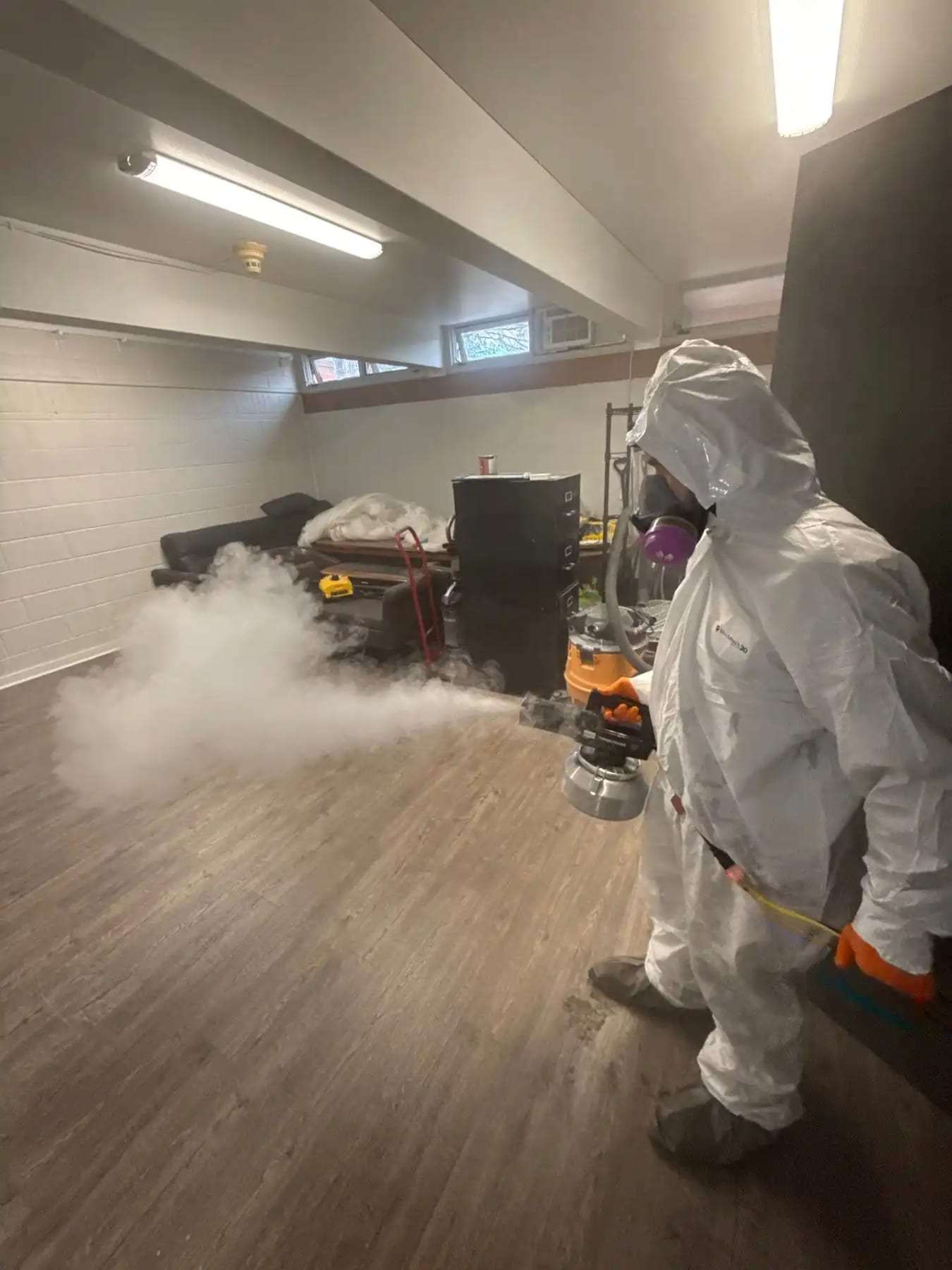
Technician in a protective suit fogging a room with a thermal fogger. One example of what this stage can look like; it is not a job connected to this site.
How the options fit together
Think of skunk odor treatment in three layers. The first is the source: wherever the spray physically landed. That is where enzymes, oxidizers and removal do their work, outdoors under the porch or deck and indoors on fabrics and floors. The second is the structure: wood framing, subfloor, drywall and trim that absorbed odor secondhand. Treatment and, where needed, sealing primers handle that. The third is the air, including the HVAC system, which can carry odor long after the source is clean.
Air treatments, such as hydroxyl or ozone, belong at the end, after the source and structure are dealt with. Used first or alone, they tend to give a day or two of relief followed by a return of the smell.
Do-it-yourself versus hiring help
Often manageable yourself
- A spray in the open yard that did not reach the house
- Washable clothing and bedding
- A car that needs washing and a new cabin filter
- Removing and replacing mulch in a bed
- Light odor on hard outdoor surfaces
Often worth professional help
- Spray inside a crawlspace or under a porch attached to the house
- Odor carried through the ductwork
- A finished basement room with carpet, drywall and furniture
- Smell that returns after you have already cleaned twice
- Any situation involving insulation or possible asbestos-era materials
General information for Washington Park, not a quote or professional advice. In an emergency, call 911.